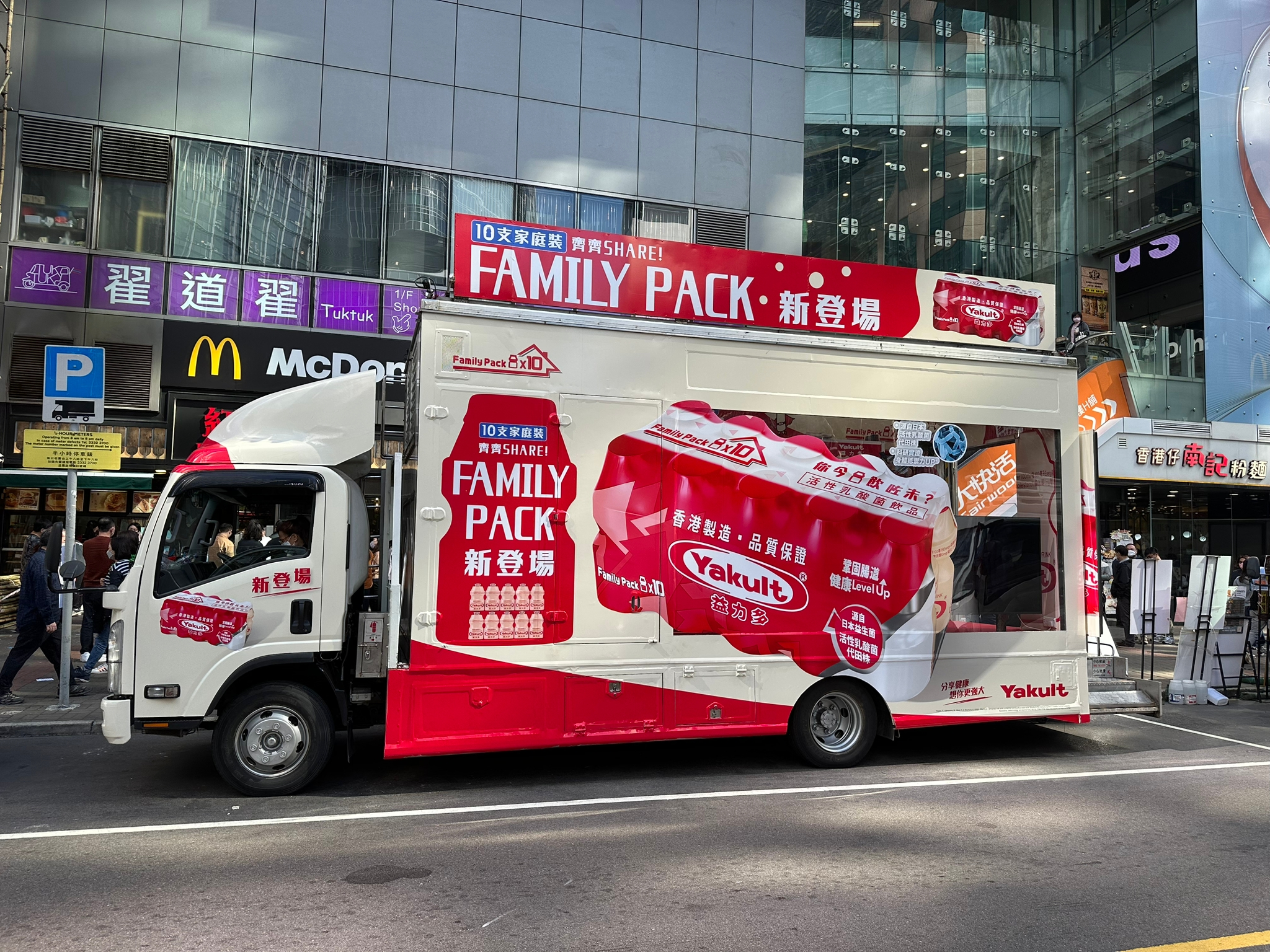
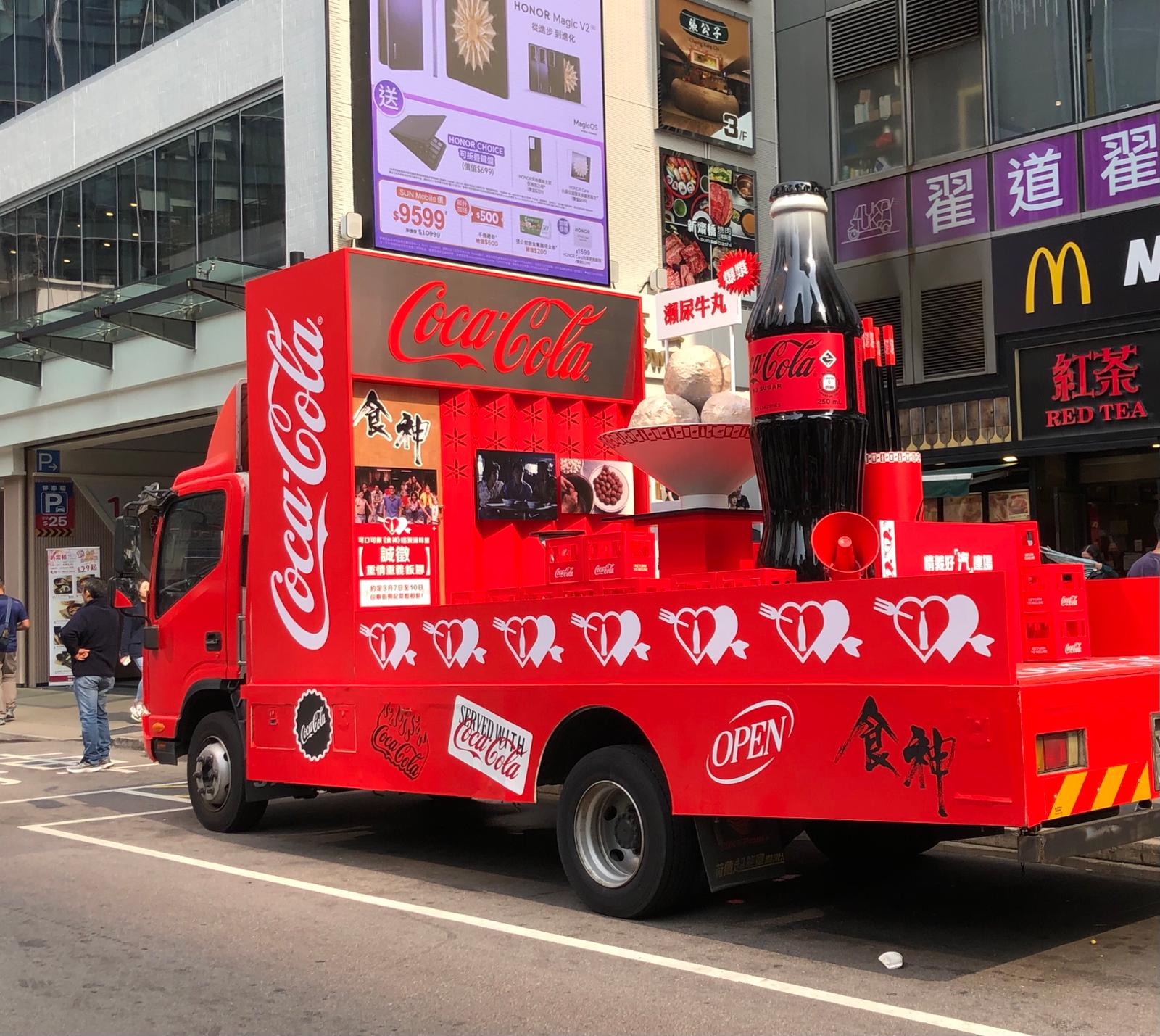
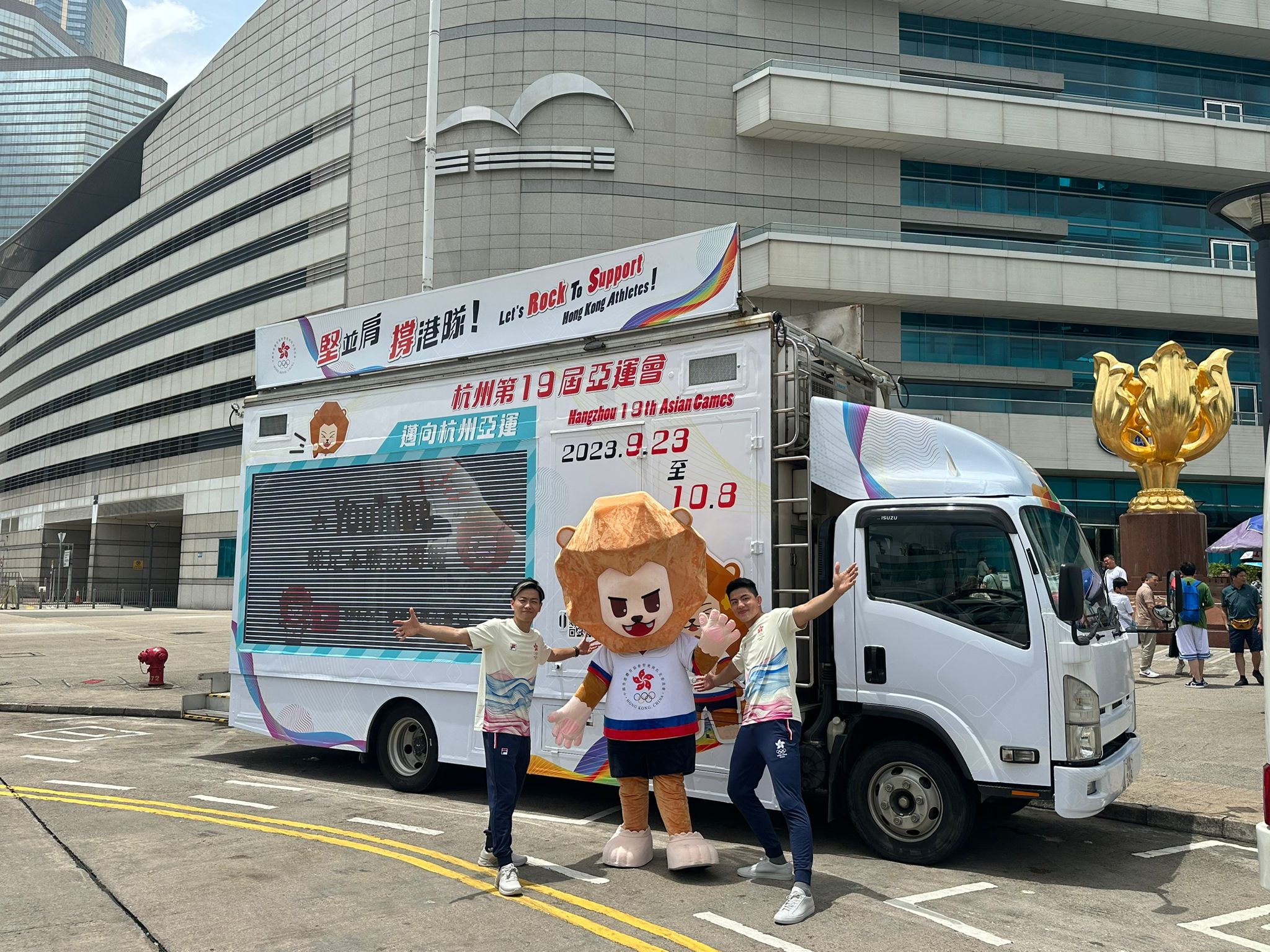
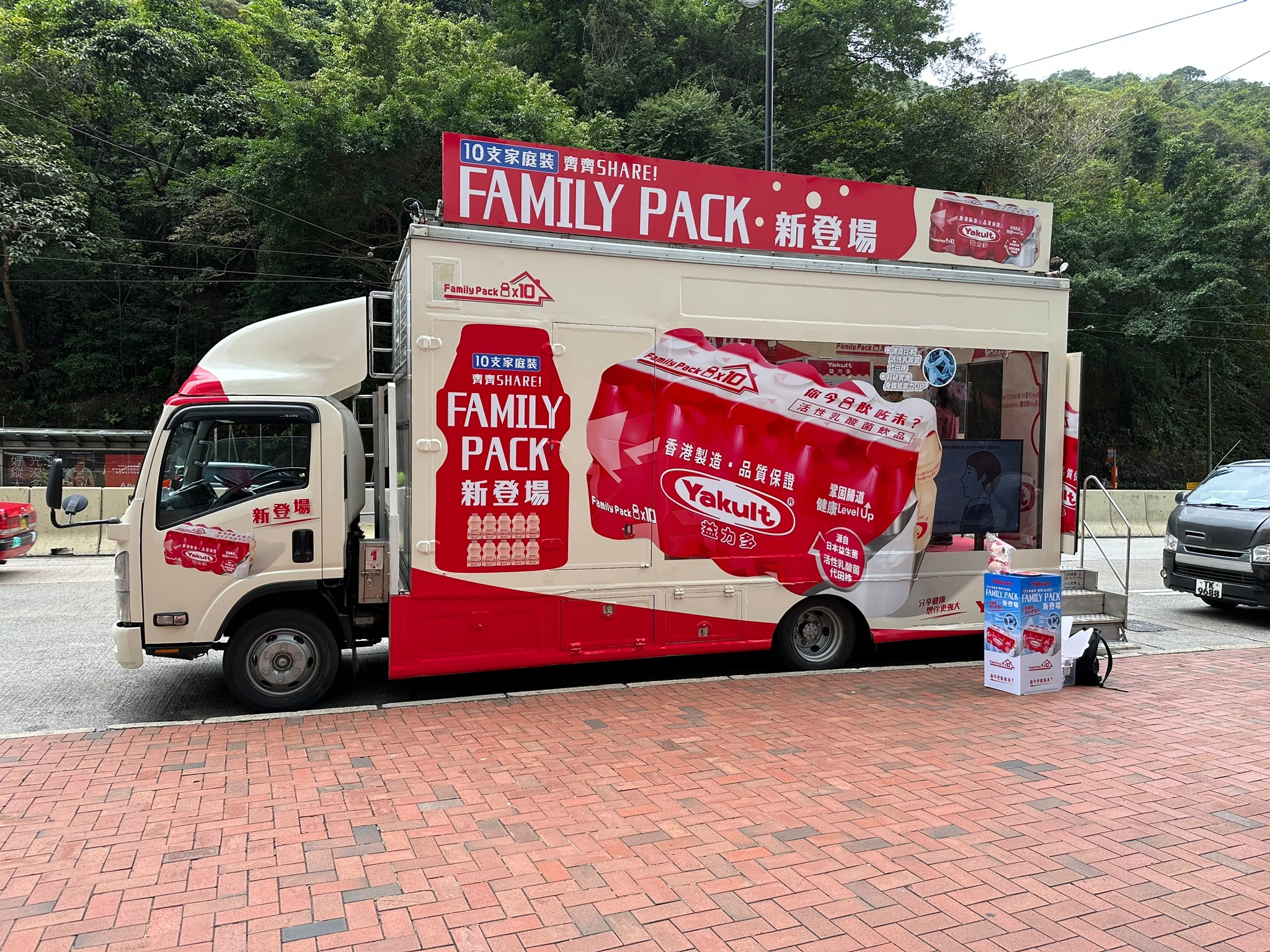
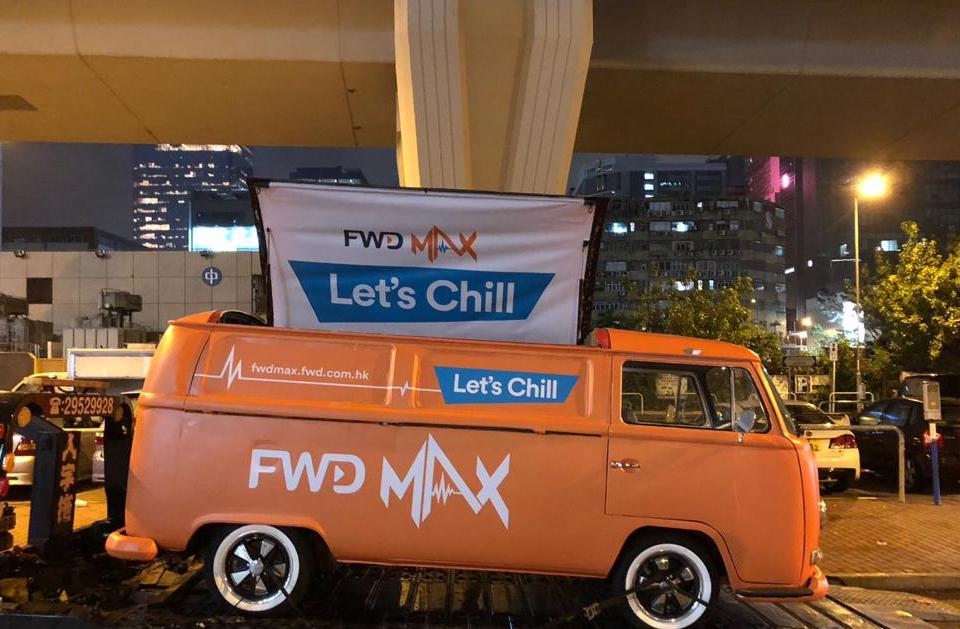
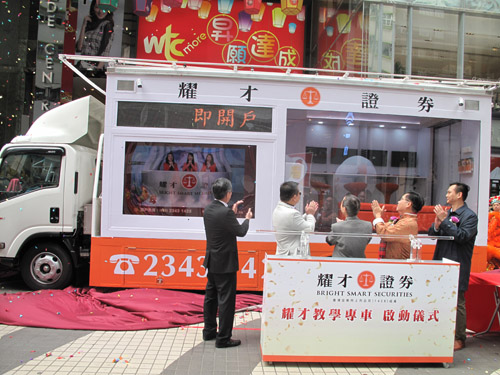
Mobile showroom truck
A large vehicle with opening side or rear doors creates a mobile showroom for product trials, sampling and pop-up shops.

Mobile Billboard · Hong Kong
PEAKVEIN provides advertising truck rental, mobile promotional vehicle hire and LED advertising truck、Mobile stage truck、Mobile exhibition trucks and Event production as a complete service. With nearly ten years of practical experience, we own and operate every vehicle. We handle vehicle graphics, LED content, route planning and on-site staff for campaigns on the street, in shopping districts and at event venues.
Fleet
A large vehicle with opening side or rear doors creates a mobile showroom for product trials, sampling and pop-up shops.

Eye-catching styling and access to narrow streets make these vehicles ideal for photos and social media interest.

Play videos and moving content, visible by day and night, for brand roadshows and limited-time offers.

The vehicle opens into a stage for roadshows, prize draws, bands and MC-led audience interaction.

The most manoeuvrable and affordable option, suitable for extended daily tours combined with leaflet distribution.

The roof opens to create a stationary display and photo spot at shopping centres, hotels and exhibition venues.
Unsure which vehicle to choose? Start with How to Choose a Mobile Advertising Vehicle: Five Types Compared, or simply tell us about your event and we will recommend a suitable combination.
Quick answers
If you have only two minutes, these are the key answers Hong Kong clients most often need when enquiring about advertising truck rental. For more detail, jump to the sections below or explore our mobile billboard knowledge hub。
About the medium
Mobile advertising trucks, also called promotional vehicles or mobile billboards, take out-of-home advertising onto the street. Their main difference from a fixed billboard is mobility: the same vehicle can reach office workers outside business buildings in the morning, visit restaurant streets at lunchtime, then head to shopping centres and residential areas in the evening. This reaches several different audiences in one day. For an introduction to the medium, read What Is a Mobile Billboard? An Introductory Guide for Hong Kong Brands。
The first is vehicle wrap advertising: large printed graphics or film cover the body, using static imagery for street exposure. It has the lowest cost and greatest durability, making it suitable for long-term brand building. The second is LED screen advertising: a high-brightness LED screen shows videos, animation and time-limited offers. Its strong night-time visibility suits short promotions and product launches. The third is interactive or display vehicles: mobile exhibition vehicles, stage trucks and pop-top vintage vans. The aim is to encourage people to stop and participate through sampling, trials, prize draws and performances, rather than simply notice a passing vehicle.
Hong Kong's dense population and the proximity of business districts, residential areas and transport hubs allow one route to pass through several consumer groups. Busy pavements put vehicle graphics in a prominent position when traffic moves slowly or stops at lights. Good fixed advertising sites are also scarce and often require long contracts, making suitable placements difficult for short campaigns. Mobile advertising vehicles fill this gap, allowing a route to be decided one day and used the next.
The following situations share a need to create repeated impressions within a short period, at specific locations and among a defined audience: store openings, product launches, limited-time offers, seasonal promotions, concert and sporting-event promotion, directing visitors from exhibition surroundings, property launches and show flats, restaurant openings and food festivals, app and game downloads, recruitment, charity campaigns and public-policy communication. Each needs different route density, timing and creative design. We clarify the goal before quoting.
Compare
PEAKVEIN owns and designs all its promotional vehicles. We control vehicle condition, equipment and availability directly, without third-party subletting. The six types below are organised by their main purpose to help you match them to your campaign. For full specifications and reference photos, visit Our services to explore each type.
| Vehicle type | Main purpose | Typical uses | Graphics / equipment highlights | Details |
|---|---|---|---|---|
| Mobile showroom truck | Mobile exhibition / mobile showroom | Product trials, sampling, pop-up shops and exhibition surroundings | Large vehicle graphics, with side or rear doors opening into display space | Mobile showroom truck |
| LED advertising truck | Repeated exposure through moving images | Product launches, limited-time discounts, concert promotion and brand roadshows | High-brightness LED screens supporting MP4 video and JPEG images | LED advertising truck |
| Mobile stage truck | Live performances and roadshows | Roadshows, prize games, band performances and MC-led interaction | The vehicle opens into a stage, with optional sound and lighting | Mobile stage truck |
| Mini vintage van | Distinctive styling and photo opportunities | Weddings, fashion brands, social media content and shopping centre displays | Retro styling with custom vehicle graphics and decorations | Mini vintage van |
| Mini promotional truck | Highly manoeuvrable vehicles for ongoing tours | Fixed daily routes, narrow streets and coordinated leaflet distribution | Solar power equipment, a load capacity of up to 1000 kg and Wi-Fi | Mini promotional truck |
| T2 pop-top van | Stationary displays and photo spots | Shopping centre atriums, hotel entrances, exhibition stands and opening ceremonies | An opening roof for stationary displays, with generators available to hire separately | T2 pop-top van |
If messages change frequently, such as daily offers, countdowns or limited-stock alerts, an LED truck may be more economical: changing the file replaces the content without rewrapping the vehicle. If the message stays the same throughout the campaign and the priority is longer exposure at lower cost, traditional vehicle graphics are more suitable. For a detailed comparison, read LED Trucks vs Traditional Vehicle Advertising: Which Works Better?and The Benefits of Mini Promotional Trucks: Reaching Further into Local Communities。
Many clients use more than one vehicle type. Three common combinations are an LED truck for street exposure with a stage truck at the event; a multi-purpose exhibition vehicle for stationary sampling with a mini promotional truck bringing in visitors from nearby streets; and a vintage van as a photo spot to generate social content that is then shown on an LED truck.Event production Our team coordinates routes, staff and materials to reduce mistakes between suppliers.
Pricing
There is no single answer to how much advertising truck rental costs, but the pricing structure can be clearly explained. Below are public market reference ranges in Hong Kong, followed by a breakdown of the individual costs. For a detailed analysis, read Advertising Truck Rental Costs in 2026: How Mobile Billboard Prices Are Calculated and Hong Kong Mobile Promotional Vehicle Costs in 2026: Daily, Weekly and Monthly Reference Prices。
| Rental period | Market reference range: LED / mobile advertising trucks | Suitable uses |
|---|---|---|
| Daily rental | Approximately HK$2,500–HK$5,500 per day | Opening days, launches, one-day promotions and event venues |
| Weekly rental | Approximately HK$35,000 per week | Seasonal promotion weeks, exhibitions and the first week of a store opening |
| Monthly rental | Approximately HK$90,000–HK$105,000 per month | Property launches, long-term brand building and ongoing recruitment |
A common approach in Hong Kong is for the base quotation to include the vehicle, driver, fuel and one return tunnel journey, with the driver's working time stated as eight consecutive hours. Common advertised schedules include 10 am–6 pm or 10 am–10 pm, sometimes with a one-hour break. How much actual driving fits into your booked hours depends on route length and traffic, so route planning directly affects exposure efficiency.
Common extras include overtime, typically around HK$200–HK$300 per hour in the market; additional tunnel tolls and harbour crossings; parking and loading arrangements; generator hire; printed vehicle graphics or wraps; LED video and image production; event staff such as MCs, sampling staff and security; props and materials; and extra fuel for longer routes across districts. Such charges can be reasonable, but they should be itemised in the quotation.
Ask for written confirmation of seven points: when the eight-hour period starts and ends and whether waiting or traffic counts as working time; overtime rates and minimum billing units; included tunnel journeys and charges for additional trips; whether fuel costs are capped; the number of artwork revisions included; cancellation or rescheduling notice periods and charges; and compensation arrangements for weather, road closures or vehicle breakdowns. Our quotation sets out all seven points, with corresponding contract terms.
Vehicle and equipment—larger screens and additional sound or interactive equipment increase costs.Rental duration—longer bookings usually reduce the average daily rate.Operating area—traffic and parking are more complex in core business areas such as Central, Causeway Bay and Tsim Sha Tsui, increasing costs.Operating hours and route—hourly costs increase with longer routes and busier operating periods.Content production needs—custom design, video production and multiple revisions are reflected in the quote.Additional services—event planning, on-site photography, staff recruitment and execution are separate items. Supply is tighter during Christmas, Lunar New Year and major exhibitions, reducing price and scheduling flexibility. Plan ahead with Seasonal Promotional Truck Planning: Christmas and Lunar New Year Schedules.
Rental term
A longer rental is not automatically better; the duration should match the lifespan of the message. A concentrated one-day campaign and a month of lower-frequency repetition produce different results. For the full calculation method, read Short-Term vs Long-Term Advertising Truck Rental: Which Offers Better Value?。
An opening day, launch, the evening before a concert or a one-day pop-up has a message that expires after that date, making daily rental appropriate. Focus the eight hours on peak pedestrian periods and a few streets with the highest concentration of the target audience. Repeated visits to the same stretch are preferable to spending the day travelling merely to cover more districts.
The first week of a store opening, a seasonal sale or an exhibition needs several consecutive days of visibility to build recall. A weekly rental can use different daily routes: concentrate within 300 metres of the store on day one, expand to nearby shopping centres and MTR exits on days two and three, then bring in visitors from neighbouring districts from day four. For a practical example, see A Three-Day Mobile Billboard Plan to Drive Footfall for New Store Openings。
Property launches often run for several weeks, while recruitment and brand building are ongoing. Monthly rental offers the lowest average daily rate, and LED content or parts of the vehicle graphics can be changed to carry messages for different campaign stages. Longer bookings also help establish regular routes, creating familiarity among people who see the vehicle daily.
The usual minimum billing unit is a day. For printed vehicle graphics or a full wrap, allow 7–14 working days for design, proofing, printing and fitting. Replacing LED content takes less time, but files should still be supplied three working days ahead for size and colour checks. During peak periods, reserve vehicles and dates three to four weeks in advance.
Production
Alongside rental, PEAKVEIN offers complete promotional vehicle production: sticker design, manufacture and fitting; LED screen installation; vehicle sound and power; and full vehicle modifications. For the practical stages and schedule, read Advertising Truck Production: From Vehicle Design and Printing to LED Conversions。
A common mistake is to design on a flat layout without accounting for door gaps, wheel arches, hinges or curved panels, leaving text broken or key graphics obscured when fitted. Before preparing artwork, we use the vehicle's actual panel layout and place the brand name and call to action on flat surfaces at eye level. Graphics must not obstruct the windscreen, the driver's field of vision, required lights, reflectors or number plates. These basic requirements of the Road Traffic (Construction and Maintenance of Vehicles) Regulations must be addressed during design to avoid redoing the finished wrap.
LED truck screen specifications vary considerably. Common Hong Kong market examples include side screens around 2.4 m high × 5.76 m wide and rear screens around 2.4 m high × 2.24 m wide. Other configurations are around 2.24 m high × 3.52 m wide at 560 × 880 pixels. MP4 video and JPEG images are common formats. Screens can be unusually wide or narrow, so standard 16:9 or 1:1 social media assets are likely to be distorted or cropped. Confirm the actual screen dimensions and pixels with us, then redesign to that aspect ratio, using text that pedestrians can read from 10–20 metres away.
Adding LED screens, roof displays, sound systems or stage structures affects weight distribution, power and secure installation. Transport Department guidance advises seeking the vehicle manufacturer's or agent's advice or consent before modifications, which may otherwise invalidate the warranty. Some alterations may also need to be reported to the Department. Mini promotional trucks have solar power equipment, while generators can be hired separately for stationary vehicles such as T2 pop-top vans. We check power and fixings before every deployment.
We provide creative design, advertising copy and video production as part of a complete service; design is generally charged separately. Our technical team responds to equipment issues during campaigns, while longer rentals receive regular maintenance to keep equipment operating throughout the booking.
Coverage
With the same vehicle and budget, good route planning can multiply exposure efficiency. We design a mix of touring and stationary stops around the brand's target audience, operating hours and competitor locations. For district-by-district analysis, read Mobile Billboard Campaigns Across Hong Kong's 18 Districts: Where Is Exposure Highest?。
Central, Admiralty, Wan Chai, Causeway Bay, Tsim Sha Tsui and Mong Kok are primary campaign areas. They offer substantial purchasing power and dense pedestrian traffic, but also congestion, loading restrictions and limited parking. These routes suit finance, insurance, luxury, food and retail brands. Slow passes and brief stops are generally preferable to prolonged stationary activity.
Kwun Tong, Kowloon Bay, Quarry Bay, Tai Koo, Lai Chi Kok and Cheung Sha Wan have concentrated office populations, with footfall peaking at lunchtime and after work. Traffic pressure is lower than in core districts. These areas suit B2B services, recruitment, lunch promotions and apps, often offering better value than prime business areas.
Sha Tin, Tai Po, Tsuen Wan, Kwai Tsing, Yuen Long, Tuen Mun, Tseung Kwan O and Tung Chung mainly serve families, with shopping centres as pedestrian hubs. They suit consumer goods, family products, education, property and healthcare services. Peak periods tend to be evenings and weekends, with routes centred on shopping centres, markets, schools and transport hubs.
Many projects need the vehicle to stop as well as tour: around shopping centres, exhibition centres, schools, piers, boundary crossings and concert venues. Stationary displays suit sampling, trials, prize draws and photo opportunities. In these cases, Mobile exhibition trucks、Mobile stage truck and T2 pop-top van can be more effective than vehicles focused solely on passing exposure.
Our routes can cover all 18 Hong Kong districts: Central and Western, Wan Chai, Eastern, Southern, Yau Tsim Mong, Sham Shui Po, Kowloon City, Wong Tai Sin, Kwun Tong, Tsuen Wan, Kwai Tsing, Sha Tin, Tai Po, North, Yuen Long, Tuen Mun, Sai Kung and Islands. Routes can be adjusted to client requirements, with a written route plan supplied before deployment.
Use cases
Mobile advertising vehicles can serve almost any industry seeking greater visibility, but the best approach differs substantially. Below are key approaches by industry. For more examples, explore the industry case studies in our insights section.
| Industry / application | Suggested vehicles | Key campaign approach |
|---|---|---|
| New store openings and opening-day promotion | LED truck + mini promotional truck | Start three days before opening, with frequent repeat visits within 300 metres of the store. |
| Product launches and new releases | LED truck + mobile exhibition vehicle | Deploy at the launch venue, with sampling and trials to build a product experience. |
| Restaurants and food events | Mini promotional truck + LED truck | Target lunch and dinner periods, with clear prices and locations in the artwork. |
| Retail sales and discount promotions | LED truck | Create urgency with countdowns and limited-availability messages, updating content daily. |
| Property launches and show flats | LED truck on monthly hire + stage truck | Build local familiarity through a longer booking, adding a stage truck at the launch. |
| Concerts, sporting events and exhibitions | LED truck + stage truck | Build anticipation and direct visitors around the venue, supported by video content. |
| App and game promotion | LED truck + vintage van | Use distinctive styling to create photo opportunities and turn street exposure into social content. |
| Recruitment campaigns | Mini promotional truck + vehicle graphics | Target industrial and office areas where the desired candidates gather. |
| Finance, insurance and IPO branding | LED truck + vintage van | Target suitable hours in core business districts, prioritising image and credibility. |
| Charity and public-policy campaigns | Exhibition vehicle + stage truck | Combine stationary displays with explanations and interaction, keeping messages clear. |
Further reading: Promoting a Product Launch: A Complete Mobile Billboard Plan for Brand Exposure|Mobile Billboards for Food Businesses: Restaurant and Food Event Promotion|Stage Trucks and Mobile Billboards for Property Launches and Major Events
Results
A frequent criticism of outdoor advertising is that results are difficult to quantify. Mobile advertising vehicles can be easier to document than fixed billboards because each journey and stop has a recorded time and location. For a full cost-effectiveness comparison, read Mobile Billboards vs Outdoor Billboards: Comparing Cost-Effectiveness。
We recommend three levels of measurement. First, route records—routes, times, stops and actual driving hours provide evidence of delivery. Second, on-site documentation—photos and short videos support reports and can be reused on social media. Third, response metrics—dedicated QR codes, offer codes or short links connect street exposure with enquiries, store visits or downloads. This third level is often overlooked, yet provides the clearest evidence of response. Plan it during artwork design.
| Medium | Location flexibility | Updating the message | Suitable duration | Characteristics |
|---|---|---|---|---|
| Mobile advertising trucks | High; routes can change on the day | LED content can be changed immediately | One day to several months | Can match event locations and times, with on-site interaction |
| Outdoor billboards | Low; fixed locations | Requires reprinting and reinstallation | Usually monthly or quarterly | High exposure at one site; prime locations are limited |
| Bus exterior advertising | Medium; follows scheduled routes | Requires a new wrap | Monthly or quarterly | Wide route coverage, but advertisers cannot choose operating times or stops |
| Taxi advertising | Medium; follows passenger journeys | Depends on the format | Monthly or quarterly | Transport Department arrangements permit electronic roof displays, advertising along both vehicle sides and on part of the rear windscreen. |
| Tram and minibus advertising | Low to medium; fixed routes | Requires a new wrap | Monthly or quarterly | Regional coverage, suitable for brands serving particular routes |
Four practical steps: concentrate operating hours at pedestrian peaks instead of spreading them evenly through the day; repeat shorter routes to reduce unproductive driving; give each design one clear message, prioritising legibility at a distance over decorative complexity; and arrange photography so the same campaign also produces social media material, spreading the overall cost.
Compliance
Compliance distinguishes professional providers from informal vehicle hire. The following framework summarises Hong Kong rules directly relevant to mobile promotional vehicles for planning purposes. For individual projects, follow the latest guidance from the Transport Department, Environmental Protection Department and other relevant authorities, and seek clarification in advance where necessary.
Section 52A of the Road Traffic Ordinance (Cap. 374) sets out restrictions on advertising vehicles, meaning vehicles used or intended primarily for displaying advertisements. A person must not drive or use such a vehicle without a permit from the Commissioner, or in breach of its conditions. An owner may apply and pay the prescribed fee, and the Commissioner may impose conditions including a validity period. Public reports state that a first conviction can carry a HK$5,000 fine and three months' imprisonment, with a HK$10,000 fine and six months' imprisonment for subsequent convictions. The Transport Department issues these permits only for non-commercial uses. As at 2 September 2025, seven valid advertising vehicle permits had been issued.
A common approach for commercial brands in Hong Kong is to place vehicle graphics on properly registered goods vehicles or vans. The design must meet the Road Traffic (Construction and Maintenance of Vehicles) Regulations: it must not obstruct the driver's view, including the windscreen and front portions of the driver's side windows, or cover mandatory lights, reflectors or number plates. We check artwork against these requirements and retain panel layouts and fitting records. For unusual installations or formats, we recommend enquiring with the Transport Department or obtaining written confirmation first.
Music or announcements from promotional vehicles are subject to the Noise Control Ordinance (Cap. 400). Under section 5(1)(b), at any time, noise from a loudspeaker, megaphone or other amplifying device in domestic premises or a public place is unlawful if it causes annoyance amounting to a nuisance.This provision also applies to loudspeakers fitted to vehicles. The Environmental Protection Department consulted on amendments in 2023, including a proposed ban on loudspeaker hawking in or near public places. Check its latest announcements for legislative progress and commencement arrangements. In practice, we recommend prioritising visual content, keeping sound restrained and avoiding amplification in densely populated residential areas or at night.
Transport Department modification guidance states that the manufacturer's or agent's advice or consent should be obtained before alterations, which may otherwise invalidate the warranty. LED screens, roof displays, stage structures and large sound systems all require careful assessment of weight, power and secure installation.
Stationary roadside displays must follow ordinary traffic and parking rules and must not park illegally or obstruct the road. Leaflet distribution, promotional giveaways and display stands may also involve cleanliness, obstruction and venue-management requirements. Activities within private shopping centres, estates or pier premises need prior consent from management. We help assess loading and stopping locations during route planning.
Vehicles must have valid third-party risks insurance. For public participation, stage performances or interactive sampling, we also recommend considering public liability insurance. Relevant Transport Department permit applications require documents including valid third-party risks insurance.
This is general information, not legal advice. Follow the latest official guidance or professional advice for the compliance requirements of a particular event.
How it works
The process usually takes one to three weeks, depending on vehicle production requirements. We provide written confirmation at each stage rather than relying on verbal commitments.
Tell us about the event, target audience, intended areas and exact dates. These determine the vehicle and rental period and should be established before discussing prices.
We recommend one or two vehicle combinations and confirm availability for the date. Peak-period bookings are allocated on a first-come, first-served basis.
We supply a written route plan covering touring sections, stationary locations and timing, and assess loading and parking feasibility.
The quote sets out vehicle hire, driver hours, fuel and tunnel allowances, overtime, production, extra staff, and cancellation and rescheduling terms. The contract is signed after confirmation.
Printed graphics or wraps are prepared on the vehicle layout and checked for compliance. LED content follows the actual screen dimensions and pixels, with brightness and readability tested on the vehicle before deployment.
The vehicle follows the route, with on-site operators handling equipment checks, playback and event management. We document the campaign with photography and compile route and photo reports afterwards.
Our story
PEAKVEIN is a specialist advertising vehicle company offering vehicle rental and mobile promotion. With nearly ten years of experience, we have established recognition and a strong reputation in the Hong Kong market. Since our founding, we have provided businesses with innovative, flexible and efficient mobile campaigns to increase brand visibility and support business growth. For more company background, see About us。
Over nearly ten years, we have built extensive experience and delivered comprehensive promotional vehicle services across industries. We tailor mobile campaigns for retailers, restaurants, manufacturers and entertainment companies, helping them increase exposure and strengthen their market position. As the rental market has developed, we have expanded our vehicle ranges to meet different industry requirements. Our vehicles support both brand visibility and direct interaction with potential customers for deeper engagement.
PEAKVEIN puts clients first, tailoring advertising vehicle plans to their needs. We use current technology and services to bring creative ideas to audiences, while exploring new opportunities and service formats to improve campaign results. Client feedback matters: we adapt rental strategies to market conditions and expectations. Whether the campaign is a major brand promotion or a small event, we develop an appropriate plan and attend carefully to each detail.
We continually improve existing services and develop new ones. Growing demand for fresh advertising formats has led us to invest in advanced mobile advertising equipment. From conventional vehicle graphics to LED screens and interactive vehicles, we offer a range of options. We also work with businesses and advertising agencies to expand the services available. Whether delivering live advertising at an event or running a campaign through city streets, we provide complete solutions for different settings.
We own and design our promotional vehicles, directly managing their condition, equipment and bookings without third-party subletting. For clients, this means clearer pricing, faster adjustments, checks by the same team before deployment and clear responsibility.
PEAKVEIN handles the preparations, from selecting a vehicle and creating custom designs to planning and running the campaign. Tell us what you need and we manage the rental process to help the campaign run smoothly. Related services include event planning, vehicle sticker design, manufacture and fitting, and event staff recruitment and management.
Our vehicles can travel flexibly between districts and be adapted to specific client needs. We can adjust the exterior design and presentation of advertising content to reach the intended audience. Beyond standard promotional vehicles, we offer a range of higher-specification options to suit different requirements.
Our mobile advertising vehicles cover Hong Kong, helping you reach potential customers across its districts. Their mobility allows routes to be chosen around your requirements and coverage objectives, from busy commercial areas to specific event venues.
Each vehicle carries suitable equipment, such as high-definition LED displays, sound systems and power supplies, to present advertising clearly and strengthen its visual impact. Route and photography records are also available to help clients assess campaign performance.
PEAKVEIN offers reasonably priced mobile advertising vehicle rental with transparent charges and no hidden fees. Flexible pricing arrangements for short bookings and long-term partnerships help clients make the most of their campaign budget.
Clear pricing builds trust. We explain base rental, equipment, production and additional service costs so there are no hidden charges. Every client receives a detailed quotation covering rental duration, operating areas, equipment and custom requirements, reflected in the contract so both parties share the same understanding. Clients can understand the full cost before signing, reducing later disputes.
FAQ
These common questions cover advertising vehicle rental and mobile promotion, including pricing, booking, production, routes and compliance.
We recommend at least one week, particularly around holidays, promotions and other busy periods when demand is higher. For printed graphics or a full wrap, allow an additional 7–14 working days for design, proofing, printing and fitting. Regular bookings are available for long-term clients. Contact us for urgent requirements, although available timing and prices may be more limited.
Costs depend mainly on rental duration, vehicle type, operating areas and custom content. Total costs generally rise with longer bookings or wider coverage, and with equipment such as LED displays and sound systems. Public Hong Kong market information places daily LED truck rental in the several-thousand-dollar range, with lower average rates for weekly and monthly hire. We provide transparent quotations and detailed estimates based on your requirements, without hidden charges.
Common Hong Kong industry practice includes the vehicle, driver, fuel and one return tunnel journey, with eight consecutive driver hours. Extras generally include overtime, typically around HK$200–HK$300 per hour in the market; additional tunnel journeys and harbour crossings; parking and loading arrangements; generator hire; vehicle graphics or wraps; LED video and images; event staff; and extra fuel for longer routes. We itemise these in the quote and corresponding contract terms.
Ask the supplier to confirm seven points in writing: the start and end of the eight-hour period and whether waiting or traffic counts; overtime rates and minimum billing units; included tunnel journeys; whether fuel costs are capped; included artwork revisions; cancellation and rescheduling notice periods and costs; and arrangements or compensation for weather, road closures or breakdowns. Our quotations cover all these points.
The usual minimum billing unit is a day, based on consecutive working hours. Short bookings commonly last 1–7 days; longer bookings can be quoted weekly or monthly. Half-day or special-time arrangements depend on availability and route feasibility. Explain your requirements when enquiring so we can assess them.
Match the rental to the lifespan of your message. Date-specific openings, launches and one-day pop-ups suit daily hire focused on peak footfall. Opening weeks and seasonal promotions suit weekly hire with changing daily routes. Property launches, recruitment and long-term branding suit monthly hire, with the lowest average daily rate and the option to change content during the booking.
Specifications vary by vehicle. Common Hong Kong market examples include side screens around 2.4 m high × 5.76 m wide and rear screens around 2.4 m high × 2.24 m wide, or screens around 2.24 m high × 3.52 m wide at 560 × 880 pixels. MP4 video and JPEG images are common formats. These unusual proportions can distort or crop standard social media assets, so confirm the actual dimensions and pixels before preparing the layout.
Allow 7–14 working days for design, proofing, printing and fitting. Use the actual vehicle panel layout and avoid door gaps, wheel arches and hinges. Put the brand name and call to action on flat areas near eye level. Graphics must not obstruct the driver's view, mandatory lights, reflectors or number plates; we address these points during artwork review.
Yes. We offer separate sticker design, manufacture and fitting, including full wraps, partial vehicle graphics and LED content for clients' own trucks or fleets. Compliance is checked during design. See our Event production page or contact us for details.
Options range from traditional static vehicle graphics to high-definition LED screens showing video, moving images and animation. Sound systems can attract attention, subject to noise-control requirements. Some vehicles also support prize draws, sampling or live performances. We tailor the format to your needs.
Yes. We serve all 18 districts: Central and Western, Wan Chai, Eastern, Southern, Yau Tsim Mong, Sham Shui Po, Kowloon City, Wong Tai Sin, Kwun Tong, Tsuen Wan, Kwai Tsing, Sha Tin, Tai Po, North, Yuen Long, Tuen Mun, Sai Kung and Islands. Prime areas such as Central, Causeway Bay and Tsim Sha Tsui offer high visibility but more traffic and parking restrictions. We account for these in a written route plan.
We agree routes with the client and provide a written plan showing touring sections, stationary stops and timing before deployment. Road closures, event changes or lower-than-expected footfall may call for adjustments within driver hours and safety limits. Please give advance notice of major changes so time and costs can be reassessed.
We provide on-site operators to start the vehicle equipment, conduct checks, play content and manage the location so the advertising runs smoothly. Additional event planners, MCs, sampling staff and engagement staff can be supplied as required.
Section 52A of the Road Traffic Ordinance (Cap. 374) restricts the driving or use of advertising vehicles without a permit from the Commissioner for Transport, who may impose conditions. Vehicle graphics must meet the Road Traffic (Construction and Maintenance of Vehicles) Regulations and must not cover the driver's view, mandatory lights, reflectors or number plates. Vehicle loudspeakers are covered by section 5(1)(b) of the Noise Control Ordinance (Cap. 400). This is general information; consult current official guidance for individual projects.
Under section 5(1)(b) of the Noise Control Ordinance, noise from loudspeakers, megaphones or other amplification in domestic premises or public places is unlawful at any time if it causes annoyance amounting to a nuisance. Vehicle-mounted loudspeakers are also covered. The Environmental Protection Department consulted on amendments in 2023, including prohibiting loudspeaker hawking in public places. We recommend prioritising visual content, restraining volume and avoiding amplification in dense residential areas or at night.
Transport Department guidance states that the manufacturer's or agent's advice or consent should be obtained before modifications, which may otherwise invalidate the warranty. LED screens, roof displays, stage structures and large sound systems affect weight distribution, power and secure installation. An experienced team should assess them and complete testing before deployment.
Vehicles must carry valid third-party risks insurance. For public participation, stage performances or interactive sampling, clients should also consider public liability insurance. Transport Department permit applications require documents including valid third-party risks insurance.
Mobile promotion offers greater flexibility and location targeting than fixed billboards or MTR advertisements. A vehicle can display messages at several locations, particularly busy business districts and pedestrian streets. Campaigns can match specific dates and times, with same-day route adjustments to reach the intended audience.
Bus and taxi advertising follows scheduled routes or passenger journeys, offering broad coverage without advertiser-selected times or stops. Transport Department arrangements allow taxi roof displays, advertising along both sides and on part of the rear windscreen. Advertising trucks offer customised routes, times and stopping points for openings, launches or directing visitors around venues, and can support on-site interaction.
We recommend three levels: route records showing routes, times, stops and actual driving hours as evidence of delivery; photos and short videos for reporting and social content; and response metrics using dedicated QR codes, offer codes or short links to connect exposure with enquiries, store visits or downloads. Plan response tracking during artwork design.
First, choose suitable equipment, such as a large LED screen for attracting attention from a distance. Second, use busy routes that match the target audience, repeating shorter routes to reduce unproductive driving. Third, give the artwork one clear message and prioritise distance readability. Fourth, choose appropriate hours and avoid low-footfall periods. Fifth, arrange photography so the campaign also produces social media material.
They suit many industries, especially those needing visibility and mobility: retail, restaurants, brand promotion, product launches, event planning, property, finance and insurance, education, app and game promotion, recruitment and charities. We adapt route density, timing and artwork to each industry's objectives.
Yes. When a promotion needs substantial attention quickly, advertising vehicles can cover a broad area. For major discounts or seasonal offers, a mix of touring and stationary activity can increase visibility and encourage direct participation. Book three to four weeks ahead for peak periods such as Christmas and Lunar New Year.
Start three days before opening. On the first day, repeat routes within 300 metres of the store, then expand to local shopping centres, MTR exits and neighbouring districts. Add a stage or exhibition truck for interaction on opening day, and photograph the activity for social media. For a detailed plan, read our practical guide to mobile billboards for new store openings。
Yes, particularly for campaigns across multiple districts or on a larger scale. Flexible routes and operating times support ongoing exposure. Content and display formats can be updated throughout a longer campaign; LED content can be changed by replacing files without rewrapping the vehicle.
We offer advertising design, usually as a separate charge. Our team can develop creative concepts, copy and video around your brand requirements and campaign goals, helping the vehicle's visuals and content appeal to your target audience.
Yes. Larger LED screens, sound systems, interactive touchscreens or camera equipment can be configured to suit the content. Every addition requires assessment of weight, power and secure installation, with the manufacturer's or agent's advice sought before modification in accordance with Transport Department guidance.
Vehicle graphics and LED trucks can operate in normal rain, but outdoor stages, sampling and work outside the vehicle may be affected. The contract sets out arrangements for severe weather, including tropical cyclone or rainstorm warnings, and any conditions for rescheduling or partial refunds. Confirm these terms before signing.
Contact our customer service team whenever an issue arises. Our technical team responds promptly to faults or operating problems, and maintenance services help keep vehicles in good condition throughout the campaign. Call (852) 2809 2908 / 2809 2909, WhatsApp 9011 3184 or email info@peakvein.com.
Start with your advertising needs. Choose an LED vehicle for visual impact and changeable content; an exhibition vehicle, stage truck or pop-top vintage van to encourage participation; or a mini promotional truck for flexible, ongoing tours. Consider the rental period, coverage and budget as well. Our team can advise, or start with Five Vehicle Types Compared: A Selection Guide。
Read more
We regularly compile information on Hong Kong advertising vehicle prices, routes, production and industry applications. Recent articles are listed below; browse them all in insights section(with more on page 2)。
Ready to roll
Tell us your dates, route and vehicle requirements. We will provide a transparent, itemised quotation without hidden charges as soon as possible. Call (852) 2809 2908 / 2809 2909.