Stage Trucks and Mobile Billboards: Event Production and the TPPE Licensing Process
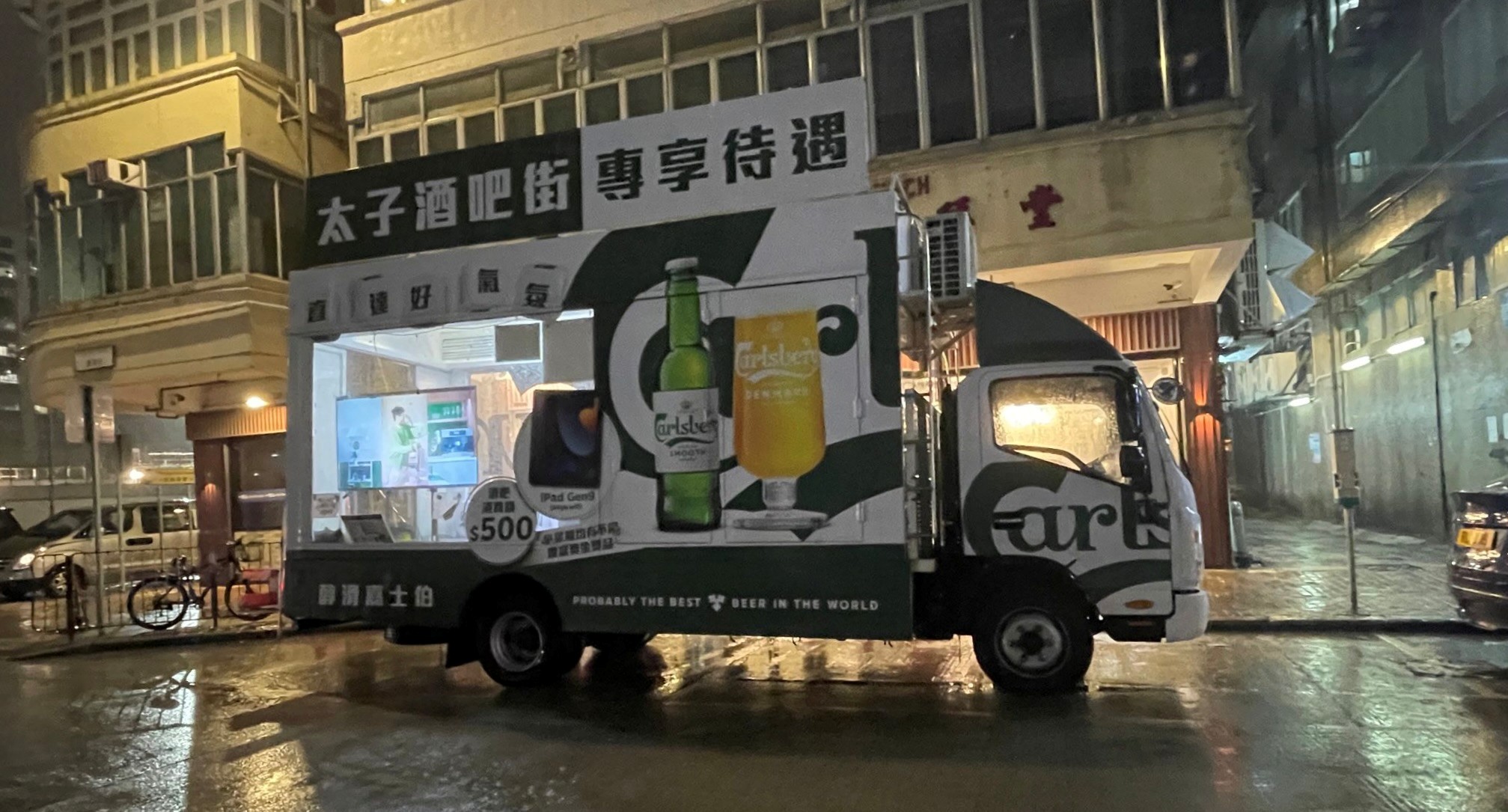
Outdoor events most often run into trouble because of their schedule. Hong Kong's Temporary Places of Public Entertainment Licence has application deadlines: at least 42 days before events involving temporary structures, or 18 days without them. Once the event date is fixed, the available time may determine whether structures are feasible. This guide works backwards from those deadlines.
1. Stage truck versus an assembled stage
The key difference may be 24 days
Speed, convenience and reduced labour are familiar comparisons. In Hong Kong, licensing can be the more significant distinction: TPPE application deadlines depend on whether temporary structures are erected.With structures, apply at least 42 days ahead for validity limited to one month. Without structures, apply at least 18 days ahead for validity up to one year: a 24-day difference.
A stage truck is a licensed vehicle that enters and leaves under its own power, with its stage forming part of the vehicle rather than a temporary building erected at the venue. It may therefore qualify for the 18-day process.However, FEHD and the relevant departments make the final classification, considering any additional stands, tents, trusses or backdrops.Adding a tent beside the truck may bring the entire event into the 42-day category.
The practical advice is: confirm the classification with the licensing authority early, then choose a feasible date.Do not announce the date before checking licensing.
Four practical advantages
- Faster setup and removal.The stage arrives with the vehicle and unfolds, reducing assembly, dismantling and venue occupation time, particularly useful for malls or government sites charged by time slot.
- Multiple stops.The same setup can serve several locations on one day or consecutive days without rebuilding a stage at each stop.
- Integrated equipment.Lighting, audio and backdrop displays are commonly incorporated, reducing supplier coordination and cabling complexity.
- The structure belongs to the vehicle.Besides the possible licensing classification advantage, this may reduce the need for temporary-structure assessment documents.
Six specifications to confirm before pricing
Stage trucks vary greatly by vehicle, weight class and unfolding mechanism, with no common market standard. Obtain these six specifications in writing rather than relying on verbal descriptions:
- Unfolded stage dimensions and usable area
- Maximum stage load, determining people and equipment capacity
- Space and clear height needed to unfold
- Vehicle height, length, gross weight and turning radius, determining routes and car-park access
- Power source and maximum output, including whether a separate generator is required
- Specifications of built-in lighting, audio and displays
Visit the PEAKVEIN stage truck page for vehicle information. If the event needs only decoration or a visual focal point at a fixed location, a T2 pop-top van with an opening roof and optional generator may be more suitable and economical.
2. The TPPE licensing process
When an application is required
Public entertainment such as concerts, film screenings, performances, exhibitions or sporting competitions at premises admitting the public requires a Temporary Places of Public Entertainment Licence from the Food and Environmental Hygiene Department under the Places of Public Entertainment Ordinance (Cap. 172) and subsidiary legislation.The key questions are whether the activity is public entertainment and whether the premises admit the public . Displaying advertisements or distributing promotional materials differs from staging performances. Once artists, bands, dance or film screenings are included, plan on licensing and enquire early.
Three application deadlines
| Event type | Minimum advance application | Licence validity |
|---|---|---|
| Temporary structures required | 42 days | Limited to one month |
| No temporary structures; excluding dance parties | 18 days | Up to one year |
| Dance party without temporary structures | Seven working days | — |
The potential one-year validity can matter for repeated activities. Brands planning multiple events without temporary structures should discuss the applicable licence scope and validity when planning the longer programme.
Application documents
Submit form FEHB 104 and four copies of the plans to the relevant FEHD Environmental Hygiene Office. Laser equipment requires a separate application. Depending on the event, industry practice also calls for a layout showing activity areas, emergency exits and seating, a fire-safety plan, public liability insurance and written venue approval. Large temporary structures listed in the guidance appendices require a structural assessment report from an Authorised Person or Registered Structural Engineer.
Departmental consultation and site inspections
Depending on the event and location, FEHD consults the Police, Fire Services Department, Buildings Department, Electrical and Mechanical Services Department, Environmental Protection Department and others. If they do not object, FEHD issues a Letter of Requirements setting out their conditions.The applicant then completes the setup. Relevant departments inspect hygiene, building and fire safety compliance and issue the necessary certificates before FEHD grants the licence.All requirements must be met no later than two days before the event. FEHD, police, buildings and fire-services officers and health inspectors may inspect premises under application or already licensed. The authority may cancel a licence for failure to meet its conditions.
FEHD provides a one-stop service, referring applications to the relevant departments for concurrent processing according to event type and location.
Food sampling and distribution need separate consideration
This is often overlooked. At public events such as exhibitions, performances, sports competitions and concerts, temporary stalls or kiosks selling reheated pre-cooked food and/or cooking pre-prepared ready-to-cook food for consumption off the premises must obtain a Temporary Food Factory Licence from the Director of Food and Environmental Hygiene before operating. Food sampling brands should address this alongside TPPE planning. For food-event deployment, see Mobile advertising strategies for food businesses。
3. Venues: government land, private sites and malls
Government land
The Lands Department, through District Lands Offices, approves applications to use government land. Obtain the relevant office's permission before holding an event on vacant government land; depending on the activity, separate licences may also be required, including public entertainment, temporary liquor or food licences.The Lands Department also provides specific guidance for temporary government-land occupation by street counters for non-profit activities.
Private sites and malls
Obtain written owner or management permission before entering a mall, private estate or other private site. Availability, insurance, access hours, power, ground loading and height clearance often make this more time-consuming than vehicle booking.Contact venue management in the same week you confirm the event date, since written venue approval is commonly part of the TPPE documentation.
The roadside is not an assumed venue
The Road Users' Code prohibits stopping in restricted zones during their operating hours, at bus/minibus stops and taxi stands, in tunnel or control areas, and on expressways. Post colours indicate typical hours: red 7am–midnight, yellow 7am–7pm, green 8–10am and 5–7pm, grey other times. Colours are only a guide; the signs govern. For full route and stopping guidance, see Mobile advertising truck routes, timing and coverage strategy。
4. Audio: resolve the rules before planning performances
Stage-truck events almost always use amplification. Section 5(1)(b) of Hong Kong's Noise Control Ordinance (Cap. 400) provides that at any time, noise from loudspeakers, megaphones or other amplification in domestic premises or public places is unlawful if it causes annoyance amounting to a nuisance. Vehicle-mounted loudspeakers are also covered.The provision specifies no acceptable noise level or assessment procedure; nuisance is the test.
Choose sites away from adjoining homes, keep sound sufficient for the audience without spreading into nearby upper floors, and avoid early mornings and nights. As a reference, election guidelines prohibit candidates' loudspeaker use from 9pm to 9am. That election-specific rule illustrates the regulator's approach to amplification hours.
The Environmental Protection Department consulted in 2023 on Noise Control Ordinance amendments, including a ban on loudspeaker hawking in or near public places and fixed penalties. Check its latest announcements for implementation status.
5. Three phases: warm-up, event day and follow-through
Phase 1: warm-up, 7–14 days before
Use an LED advertising truck to loop through the target area with countdowns and event details. LED allows daily content changes: “this month's event” at D-7, “this Saturday” at D-3 and “opening tomorrow” at D-1, without reprinting. A fixed-position QR code linking to registration or details turns street exposure into trackable sign-ups.
Centre the route on the venue and pass nearby on every loop, building anticipation. Schedule around the audience's routine rather than spreading hours evenly. See Routes, Timing and Coverage Strategies。
Phase 2: event day
The stage truck unfolds at the venue for performances, launches or prize draws. Other vehicles support nearby promotion and interaction:
- Mobile stage truck: performances, launches, host and guest segments
- Mobile showroom truck: displays, distribution, trials, gift redemption and registration
- Mini promotional truck: outreach on streets and estates inaccessible to larger vehicles; up to 1,000 kg carrying capacity, solar power and Wi-Fi for transporting supplies
- LED advertising truck: loops around the venue showing live footage or the event schedule
Coordinated vehicles require a shared command structure and staff. Consider having the event production team manage delivery. Public market staffing references include around HK$800 a day for a supervisor, HK$150 an hour for an assistant, HK$200 an hour for a promoter and HK$400 an hour upwards for a model. An eight-hour day with one supervisor, two promoters and one assistant totals around HK$5,200, to budget alongside vehicle hire.
Phase 3: follow-through, 7–14 days after
The campaign continues after the event. Show highlights and follow-up offers on LED trucks, with a clear action: a dedicated promotion code, limited registration window or in-store gift redemption.Same-day content replacement keeps additional display-production costs low while extending the event's impact for up to two weeks.
Why three phases can outperform a single day
Warm-up addresses low opening attendance; follow-through addresses being forgotten afterwards. All three phases can share one visual system and the same LED vehicle, changing only its content.
6. Fleet combinations for three event types
Opening ceremonies and new shops
Use a stage truck for the ceremony, a mobile showroom for trials or distribution, and a mini truck for local outreach. The key is to serve both media and neighbours : stage activity creates photographs, while distribution drives visits. For scheduling around an opening, see A practical three-day store-opening plan。
Product launches
Use a stage truck for the keynote, a large mobile showroom or exhibition truck for hands-on product experiences, and LED vehicles for surrounding exposure. This suits cars, appliances and large consumer products. See Complete promotional plan for product launches。
Brand roadshows
Take a stage truck to one or two venues a day, spending several hours at each, with promotional vehicles circulating nearby. This makes strong use of the reusable stage. However, each venue needs its own permission, so administrative work increases with the number of stops and must be included in the schedule.
What if there is only one stage truck?
It is feasible, but a ready stage does not guarantee an audience. Add one or two promotional vehicles for nearby outreach, or at least an LED warm-up campaign. For industry examples, see Mobile Promotion Across 10 Industries and Promotion for property launches and major events。
7. A countdown built around licensing deadlines
The milestones below are calculated backwards from application deadlines. If temporary structures are required, allow the longer process throughout.
| Timing | Key work | Basis |
|---|---|---|
| D-70 to D-56 | Set objectives and budget; ask FEHD to confirm the event classification and whether temporary structures are involved; contact venues | Classification determines the 42- or 18-day process |
| D-56 to D-49 | Secure the venue and written approval; confirm stage and promotional vehicle availability | Written venue approval is part of the application documentation |
| D-49 to D-45 | Prepare FEHB 104, four plan copies, layout, fire-safety plan and public liability insurance; arrange an AP/RSE report for relevant large temporary structures | Industry practice recommends starting documents 8–10 weeks ahead |
| D-42 at the latest | Submit TPPE application if temporary structures are required | Minimum 42-day application period |
| D-42 to D-28 | Creative design, routes, government-land application if applicable, and temporary food factory licensing where required for food activities | District Lands Office approval is required to use government land |
| D-28 to D-21 | Print and install vehicle graphics; produce LED content | Market guidance suggests about 14 days for printing and installation |
| D-18 at the latest | Submit TPPE application if no temporary structures are required | Minimum 18-day application period |
| D-14 to D-7 | Start LED warm-up campaign; invite media; plan running order and rehearsals | — |
| D-7 to D-3 | Address departmental requirements in the Letter of Requirements; confirm power, insurance and staff | Each requirement must be met before licensing |
| D-2 at the latest | Complete setup and all requirements; undergo departmental site inspections | All requirements must be met at least two days before the event |
| D-Day | Run the event; record routes and on-site delivery | — |
| D+1 to D+14 | Show highlights and follow-up offers on LED trucks; review results | — |
The most important entry is D-70: confirm classification before fixing the date.Events often have to reduce their scope after a date is announced and organisers discover the proposed structures cannot meet the 42-day application deadline.
8. Budget: request each component separately
Stage-truck rates vary greatly by model, stage size and equipment, with no standard public price suitable for quotation. As a comparable reference, one full-service roadshow supplier publicly lists HK$33,000 for a weekday, HK$60,750 for three consecutive days, HK$88,000 for a week and HK$268,000 for four weeks, including a driver, emergency coordinator, two 50-inch TVs, LED banners on both sides, generator, speakers, air conditioning, 4G Wi-Fi, carpet, and vehicle graphic production and installation.
Request six itemised budget components:
- Vehicle hire: each vehicle and day, stating usable hours and when billing starts
- One-off production: vehicle design, printing and installation, LED content, stage backdrops and materials
- On-site staffing: supervisor, promoters, assistants, host and performers, hourly or daily
- Licensing and administration: TPPE, government-land and food applications, plus professional reports
- Venue and equipment: venue hire, extra generator, sound or lighting, and insurance
- Overtime and contingencies: overtime, commonly around HK$200–300 an hour, and weather rescheduling arrangements
For a full cost breakdown, see Mobile Promotional Vehicle Costs in 2026: Daily, Weekly and Monthly Prices and Advertising vehicle hire costs in 2026 explained。
9. Frequently asked questions
What licence might a stage-truck event require?
Public entertainment such as concerts, screenings and performances at premises admitting the public requires a TPPE licence from FEHD under the Places of Public Entertainment Ordinance (Cap. 172) and subsidiary legislation. Apply at least 42 days ahead with temporary structures, for validity limited to one month; at least 18 days ahead without structures, excluding dance parties, for validity up to one year; or at least seven working days ahead for a dance party without structures. Submit FEHB 104 and four copies of the plans; laser equipment requires a separate application.
Can a stage truck avoid the 42-day application deadline?
Possibly, but do not assume it. The stage forms part of a licensed vehicle rather than a temporary building erected at the site, so it may qualify for the 18-day process. FEHD and the relevant departments decide, considering any additional tents, stands, trusses or backdrops. A tent beside the truck may put the whole event in the 42-day category. Confirm classification before setting the date.
How does TPPE approval work?
FEHD consults relevant departments, including Police, Fire Services, Buildings, Electrical and Mechanical Services and Environmental Protection, according to event type and location. If there is no objection, it issues a Letter of Requirements. The applicant completes setup, passes hygiene, building and fire-safety inspections, and obtains certificates before FEHD issues the licence. All requirements must be met at least two days before the event. Authorised officers may inspect at any time, and the authority may cancel a licence for unmet conditions.
Do food sampling or giveaways require an additional application?
Yes where the activity falls within the relevant food-business requirements. Temporary stalls or kiosks at public events selling reheated pre-cooked food and/or cooking pre-prepared ready-to-cook food for off-premises consumption need a Temporary Food Factory Licence before operating. Handle this alongside TPPE rather than waiting for that approval. Food sampling brands should include it in the timetable.
Who approves events on government land?
The Lands Department, through the relevant District Lands Office, approves use of vacant government land. Depending on the activity, separate public entertainment, temporary liquor or food licences may also be needed. Land permission and event licensing are separate applications to handle concurrently. Specific guidance also covers temporary street counters on government land for non-profit activities.
Can a stage truck run an event beside a busy street?
Do not assume roadside stopping is permitted. The Road Users' Code prohibits stopping in active restricted zones, at bus/minibus stops and taxi stands, in tunnel/control areas, on expressways and on pedestrian crossings. Post colours indicate typical hours: red 7am–midnight, yellow 7am–7pm, green 8–10am and 5–7pm, grey other times. Signs govern, not colours alone. Use a mall, private site, event venue or government land approved by the District Lands Office.
Are there time limits for stage-truck sound systems?
The cited noise provision applies at all times through a nuisance standard rather than a permitted time window. Section 5(1)(b) of the Noise Control Ordinance (Cap. 400) covers amplification in domestic premises or public places, including vehicle speakers, where noise causes annoyance amounting to a nuisance. It specifies no acceptable level or assessment procedure. Election guidelines separately prohibit candidates' loudspeaker use from 9pm to 9am. Avoid adjoining homes, control volume and avoid early morning and night-time use.
Can a stage truck be used indoors?
It depends on vehicle height, length and turning radius, and venue clearance, passage width, floor loading and unfolding space. Large exhibition venues may accommodate it through goods access, but obtain venue confirmation and measure on site. Also address exhaust and power: if onboard generation is unsuitable, use venue power or other equipment. Resolve these when confirming the venue.
How large is the unfolded stage and how many people can it hold?
There is no common standard; weight classes and unfolding designs vary greatly. Obtain six written specifications: unfolded dimensions and usable area, maximum stage load, unfolding space and clearance, vehicle dimensions/weight/turning radius, power source and capacity, and built-in lighting/audio/display specifications. Load capacity determines people and equipment limits and is especially important.
How long should we allow to prepare a stage-truck event?
Work backwards from the deadlines. With temporary structures, TPPE must be submitted at least 42 days ahead, and document preparation should begin 8–10 weeks ahead; allow about ten weeks overall. Without structures, the minimum is 18 days, but venue approvals, printing and installation (often around 14 days), and warm-up activity still require time. Five to six weeks is a more reliable overall lead time. For less than four weeks, choose an option without site-built structures or printed vehicle wraps.
Can we hire only the stage truck?
Yes, but it provides a performance space rather than an audience. Use an LED vehicle for advance awareness and ideally one or two vehicles for nearby promotion on the day. The same LED vehicle can serve all three phases with file changes, making it a flexible addition with low content-change costs.
What happens in bad weather?
Industry practice generally continues in rain, Amber Rainstorm warnings and Tropical Cyclone Signal No. 3, with other arrangements for higher warnings. The Labour Department's Code of Practice in Times of Adverse Weather and “Extreme Conditions” calls for outdoor and exposed work to stop and workers to seek shelter under Signal No. 8 or above, a Black Rainstorm warning or government-declared extreme conditions. Signal No. 8 corresponds to sustained winds of 63–117 km/h; Black Rainstorm indicates widespread rainfall exceeding, or expected to exceed, 70 mm an hour. Contracts should specify cancellation and rescheduling because performers and venues also have availability constraints.
Further reading
- Stage Trucks and Mobile Billboards for Property Launches and Major Events
- Complete promotional plan for product launches
- A practical three-day store-opening plan
- Mobile advertising truck routes, timing and coverage strategy
- Mobile billboard hire costs 2026: rates and quote breakdown
- Mobile Promotion Across 10 Industries
- LED advertising trucks versus mini promotional trucks
- 2026 mobile billboard guide
- PEAKVEIN event production services|Mobile stage truck|Mobile showroom truck|All services|Request a quote
Source
- Licensing and deadlines: FEHD · Guide to Application for Places of Public Entertainment Licences (other than cinemas and theatres)、FEHD · Guide to the licences required、Legislative Council Question 4 · Relaxing restrictions on outdoor or public space use、Legislative Council Question 5 · Temporary Places of Public Entertainment Licence applications
- Government land: Legislative Council document · Lands Department approval for government-land use、Lands Department · Temporary government-land occupation by street counters for non-profit activities
- Stopping and noise: Transport Department Road Users' Code · Places where stopping is prohibited、Electoral Affairs Commission · Guidelines on loudspeakers and vehicles、Legislative Council research brief · Street performance policy and the Noise Control Ordinance
- Adverse weather: Hong Kong Observatory · Rainstorm Warning System、Labour Department · Code of Practice in Times of Adverse Weather and “Extreme Conditions”
- Cost and operational references: Tinby Advertising · Promotional vehicle packages and staffing rates、TexWood Media · Service-hour definitions and production lead times
Licensing and regulatory information is general, not legal advice. Check current FEHD, Lands Department, Transport Department and Environmental Protection Department requirements, deadlines and documents, and enquire early about your event. Third-party prices are public references at the time of writing, not formal quotations.